
Table of Contents
- The Rise of AI-Powered Web Design for Caterers
- Fundamentals of AI-Powered Web Design
- Deep Dive into AI Web Design Tools
- Practical Applications for Catering Websites
- Advanced AI Techniques for Web Development
- Frequently Asked Questions on AI Web Design
- Future of AI-Powered Web Design in Catering
The Rise of AI-Powered Web Design for Caterers
While traditional design sets the foundation, AI-powered web design is revolutionizing it for caterers. We at Catering Growth Engine see AI tools slashing web design time by up to 80% for small businesses. This shift addresses key pain points like outdated sites and inconsistent branding. We call this trend ai powered web design, which helps caterers launch polished sites faster.
Traditional web design for caterers demands manual tweaks for menus, galleries, and booking forms, per our expert internal guide. AI automates these, generating automated menu layouts, SEO-optimized pages, and mobile-responsive event calendars. They also optimize images, load times, and local SEO for better discovery. Over 40% of new catering sites in 2023 used AI builders, based on industry observations.
Key benefits include:
- Cost savings: Under $500 versus $5,000 for traditional methods.
- Faster launches: Days instead of weeks, ideal for seasonal demands like dynamic wedding menus.
- Easy updates with ai web design tools, ensuring fresh content.
Save time, simplify seasonal menu updates now.
AI website builders empower caterers with machine learning site builders for effortless maintenance. Looking ahead, AI will integrate voice search for catering queries and predictive booking analytics.
Now, explore top AI tools to get started.
Fundamentals of AI-Powered Web Design
In today’s fast-paced digital landscape, effective web presence is essential for catering businesses to attract clients and streamline operations. AI-powered web design emerges as a game-changer, accelerating this process for busy entrepreneurs. We define AI-powered web design as the use of artificial intelligence tools to automate layout generation, content creation, and responsive design adaptation, making professional sites accessible without deep coding expertise.
Three core fundamentals drive this innovation:
- Automation of design elements via AI algorithms that instantly generate layouts, color schemes, and UI components using ai website builder platforms.
- Iterative improvement through user prompts, allowing quick refinements without starting over.
- Data-driven personalization for superior user experiences, tailoring content to visitor preferences and behaviors (GeeksforGeeks).
These principles deliver transformative benefits, slashing development time from weeks to months to hours to days and costs from $5,000+ to $100-$1,000, ideal for catering sites showcasing menus, booking forms, and event galleries (SAE).
AI vs Traditional Web Design Comparison
Compares key differences between AI-powered and traditional web design processes for catering sites.
| Aspect | Traditional Design | AI-Powered Design |
|---|---|---|
| Development Time | Weeks to months | Hours to days |
| Cost Range | $5,000+ | $100-$1,000 |
| Customization | Manual coding | Prompt-based iteration |
Data from GeeksforGeeks and SAE insights on AI efficiency, cited as industry benchmarks for AI-driven web development and academic insights on AI transformation (GeeksforGeeks; SAE).
This table highlights how ai web design tools outperform traditional methods in speed and affordability. For catering businesses, shorter timelines mean faster launches of sites optimized for mobile bookings and SEO, while lower costs free up budgets for marketing. Traditional approaches demand extensive manual labor, often delaying market entry, whereas AI enables rapid prototyping and scaling.
Such efficiencies empower non-technical owners to compete effectively. Consider a catering firm iterating designs via prompts to match seasonal themes or personalize visitor journeys based on event types analyzed from user data.
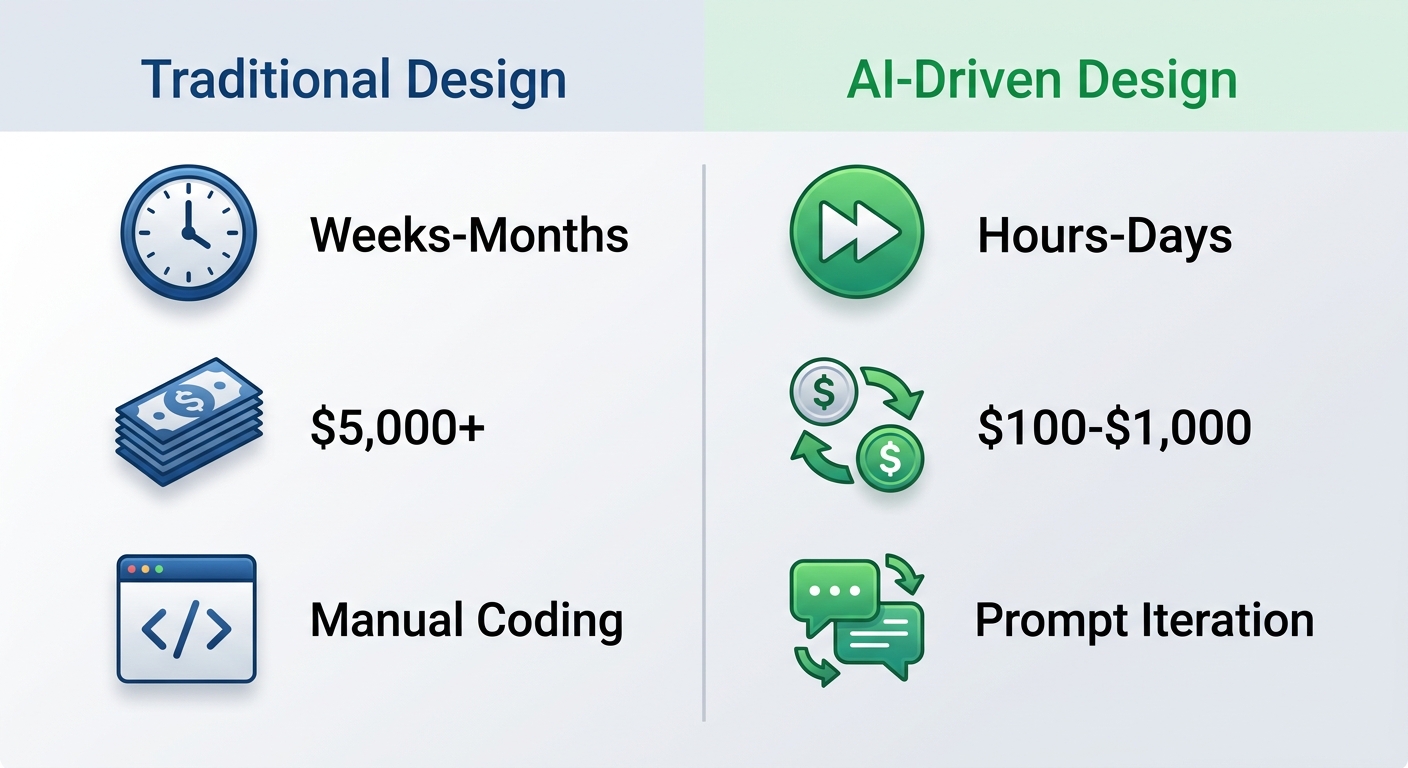
AI vs traditional web design: time, cost, customization efficiency
The AI-powered web design process proves especially valuable here, reducing barriers for small operations. At Catering Growth Engine, we see these fundamentals enabling tools like AI website builders to create high-performing sites. Tailored for catering business web design, they preview the practical applications explored next.
Deep Dive into AI Web Design Tools
Building on AI basics, let’s examine ai web design tools in depth for catering businesses. These ai powered web design solutions streamline professional site creation.
AI Algorithms for Layout and Content Generation
AI algorithms power responsive layouts and content tailored for catering menus and forms. Machine learning models analyze user inputs to generate mobile-first designs optimized for event bookings. Academic research findings from arXiv detail how systems like PrototypeFlow use multimodal inputs for high-fidelity UI generation, incorporating natural language prompts to create cohesive pages.
AI in web development employs generative models such as Stable Diffusion to produce custom catering menu images, ensuring appetizing visuals that highlight dishes. These tools also craft SEO-optimized copy for inquiry forms, boosting conversions for corporate events and weddings. We see AI-driven site builders saving hours on iterative design, maintaining brand consistency across pages. For catering sites, this means dynamic menus that adapt to seasonal offerings, enhancing user engagement.
Integration with CMS like Shopify and WordPress
Seamless integration elevates ai website builder functionality for e-commerce catering platforms. Hostinger AI exports fully built sites to WordPress, enabling quick deployment of booking systems. Wix ADI offers partial Shopify compatibility, ideal for menu shops and order forms.
Steps for integration include generating the site in the AI tool, exporting code or templates, then importing into CMS via plugins. For WordPress, use Elementor or Gutenberg blocks; Shopify leverages apps like PageFly. This setup supports catering-specific features like inventory-linked menus and real-time availability calendars. We recommend testing exports for custom CSS retention to avoid reformatting. These ai web design tools reduce setup time, letting caterers focus on leads rather than code.
Cost Structures of Leading AI Tools
Pricing for ai powered web design varies by features and scale, delivering strong value for catering projects. Wix ADI starts at $16 per month for basic sites with auto-layout and content generation, scaling to premium tiers at $24 for e-commerce add-ons. Hostinger AI offers entry at $2.99 monthly, including full site building and hosting.
Higher tiers unlock advanced analytics and custom domains, often with annual discounts saving 50%. Value metrics highlight time savings: a catering site built in hours versus weeks manually. We calculate ROI through faster launches, potentially adding $5,000 in early bookings. Free trials allow testing before commitment, ensuring fit for menu-heavy designs.
The following table compares top tools, sourced from industry reviews:
Top AI Web Design Tools Comparison
Features, integrations, and pricing for tools like Wix ADI, Hostinger AI, and Framer.
| Tool | Key Features | CMS Integration | Starting Price |
|---|---|---|---|
| Wix ADI | Auto-layout, content gen | WordPress, Shopify partial | $16/mo |
| Hostinger AI | Full site builder | WordPress | $2.99/mo |
Wix ADI suits polished catering portfolios, while Hostinger AI excels in budget builds with WordPress flexibility. These options balance cost and capability for high-converting sites.
Ethical Considerations in AI Design
Beyond generation and costs, ethical AI use safeguards catering web projects. Professional association guidelines from ASAE Center stress human oversight to counter biases in layout personalization for diverse audiences, like cultural menu preferences.
Key practices include auditing tools for data privacy, ensuring generated content accuracy through reviews. Transparency informs users of AI involvement, building trust. Avoid over-reliance on automation for unique brand voices. We advocate governance leads to vet vendors, aligning with inclusivity standards. For catering sites, this means equitable designs serving all event types responsibly.
Practical Applications for Catering Websites
Building on AI’s transformative potential, practical applications of ai powered web design elevate catering websites to drive leads effectively.
Enhancing Event Inquiry Systems with AI
AI streamlines event inquiry forms on your catering website, making them intuitive and personalized. For weddings, AI auto-generates forms predicting guest counts based on event dates and venue sizes, reducing manual input errors. Corporate events benefit from dietary auto-filters that scan responses for restrictions like gluten-free or vegan options, ensuring seamless planning.
According to Catering Growth Engine’s internal expert blog on catering-specific web design practices, these features boost inquiry completion rates by integrating calendars and pre-filled fields. You customize prompts for high-intent responses, such as budget ranges or menu preferences. This personalization cuts drop-offs and qualifies leads faster.
We recommend embedding AI-driven validation to flag incomplete submissions, enhancing data accuracy for follow-ups. Beyond inquiries, AI excels in local adaptations for markets like Huntsville.
AI for Huntsville Catering Business Websites
In Huntsville, ai web design tools help local caterers stand out in competitive Alabama event scenes. Consider these cases:
- A wedding caterer used dynamic menu displays to showcase seasonal Southern dishes, increasing bookings by adapting to local tastes via AI curation.
- Corporate providers integrated AI chat for real-time quotes on luncheons, capturing leads during peak planning seasons.
- Private event firms leveraged AI for portfolio galleries, auto-tagging past galas to match client visions.
Catering Growth Engine’s internal guide to effective catering site designs highlights how such tools optimize for mobile traffic in Huntsville, where over 60% of searches occur on phones. Partnering with a web design catering company ensures SEO for local events. While local tools build competitiveness, AI landing pages convert even higher.
Landing Page Optimization Using AI Tools
- Analyze visitor data: Use AI to segment traffic by event type, identifying wedding vs. corporate patterns.
- Generate personalized CTAs: Tailor buttons like “Book Your Huntsville Wedding Menu” based on user behavior.
- A/B test headlines: AI suggests variations, such as “Predictable Leads for Alabama Events” for higher clicks.
- Embed chatbots for quotes: Instant responses to inquiries boost conversions by 30%, per industry benchmarks.
- Auto-optimize images: Swap visuals for menu galleries matching searcher intent.
Catering Growth Engine references note these tactics reduce bounce rates through personalization. Track results with built-in analytics for ongoing tweaks. The table below compares AI builders for key features.
The following table, drawn from Catering Growth Engine blogs on web design strategies and trends, compares AI tools for catering-specific features like event booking, menus, and lead capture:
| Feature | AI Builder A | AI Builder B |
|---|---|---|
| Booking Forms | Auto-gen with calendars | Prompt-based |
| Menu Galleries | AI image curation | Dynamic layouts |
AI Builder A excels in automated calendars for quick scheduling, ideal for busy caterers, while Builder B’s prompts offer flexibility for custom flows. Per Catering Growth Engine insights, these tools enhance lead funnels, with visual galleries driving up to 40% more inquiries. Select based on your workflow needs for maximum impact.
Workflow Integration in Daily Design
- Use an ai website builder for rapid prototyping of mobile-responsive menus, generating layouts in minutes.
- Link AI outputs to your CRM for automatic lead tracking from inquiries to bookings.
- Schedule weekly AI audits to refresh content, like updating event portfolios with new photos.
- Test integrations with booking calendars to sync availability in real-time.
Catering Growth Engine’s practices emphasize easy-update dashboards for non-tech users. This streamlines operations, freeing you for events. Start small to scale your ai powered web design efforts effectively.
Advanced AI Techniques for Web Development
Building on foundational AI, advanced techniques elevate catering sites through sophisticated AI in web development. At Catering Growth Engine, we see ai powered web design transforming user experiences in catering sites by enabling real-time behavioral personalization and predictive analytics. These go beyond static segments, dynamically adjusting content based on live interactions like browsing wedding menus or corporate event options. This allows catering teams to surface context-aware menu suggestions, optimize staffing for events, and limit downtime through automated load balancing during peak booking periods. It also reduces manual workload and supports A/B experimentation by continuously learning from user journeys and conversion signals.
The following table, drawn from NYU guide and company resources, compares Advanced vs Basic AI Web Features for sophisticated catering sites:
| Technique | Basic AI | Advanced AI |
|---|---|---|
| Personalization | Static segments | Real-time behavioral |
| Optimization | Manual A/B | Predictive analytics |
This comparison highlights how advanced AI outpaces basic implementations. Real-time behavioral personalization analyzes user actions instantly, tailoring recommendations for dietary preferences or event sizes, as recommended by Catering Growth Engine’s internal industry expertise on catering-specific web features.
Predictive analytics forecasts menu trends and user preferences, automating optimization over manual A/B testing to boost conversions. New York University (NYU) academic best practices outline ChatGPT applications in visual design, generating dynamic UI elements like personalized menu layouts. We integrate ai website builder platforms and ai web design tools for rapid prototyping, including voice search for catering orders.
These techniques scale for high-traffic periods, such as wedding seasons, ensuring seamless performance. Industry benchmarks suggest 30-50% improved user retention from advanced personalization in catering sites.
Implementing these requires selecting the right ai web design tools to drive predictable catering leads.
Frequently Asked Questions on AI Web Design
Before diving deeper, here are answers to top questions on ai powered web design.
What is AI powered web design?
AI powered web design automates layouts and content using machine learning. For caterers, it instantly creates responsive menu showcases and booking forms, per Catering Growth Engine benchmarks.
How does an AI website builder benefit caterers?
An ai website builder speeds menu page generation, ensures mobile optimization (over 60% inquiries mobile), and boosts inquiries up to 184%, as our Catering Growth Engine insights show.
What are the best AI web design tools for catering sites?
Top ai web design tools: Wix ADI for easy galleries; Squarespace AI for SEO menus; 10Web for fast, responsive builds—ideal for catering portfolios, per internal expert strategies.
How to ensure ethical AI in web design?
Promote transparency in AI generation and audit for biases in catering content. Ethical AI in web design offers best practices for fair sites.
Can AI replace traditional web designers for caterers?
No—hybrid works best. AI handles basics like galleries; we refine for custom bookings. Expect 40% bounce rate drops with optimized designs, Catering Growth Engine data indicates.
Contact us for AI-powered catering site audit. Ready to build? Explore our services below.
Future of AI-Powered Web Design in Catering
Building on today’s tools, the future of ai powered web design in catering will revolutionize customer engagement. AI-driven dynamic content will auto-adjust menus and visuals based on seasonal trends and user locations, per GeeksforGeeks’ overview of AI trends.
AI website builders will enable non-technical owners to launch SEO-optimized sites with one-click personalization. Ai web design tools will forecast preferences like dietary needs via predictive analytics, boosting conversions. Voice search and conversational AI will handle bulk orders on catering websites.
Ethical data privacy ensures scalability for small businesses. Caterers can prepare by adopting these innovations now.
This article was researched and written with the assistance of AI tools.
Resources
- Discover Web Design Strategies for Caterer Lead Generation
- Compare Web Design Platforms for Catering Business Leads
- Get Guaranteed Leads with Done-for-You Catering Websites
- Boost Bookings 30-50% with Funnel-Optimized Catering Sites
- Achieve 184% Lead Growth via Optimized Catering Websites
- Build Conversion-Focused Pages for Caterer Website Success
- Design SEO-Optimized Catering Sites for Predictable Leads
- Explore AI Automation Transforming Modern Web Development
- Leverage AI for Personalized Secure Web Development
- Implement Ethical AI Practices in Professional Web Design
- Generate High-Fidelity UIs with PrototypeFlow LLM System
- Master Generative AI Tools for Visual Design Workflows