
Table of Contents
- Step 4: Evaluate Your Citation Rate Against Benchmarks
- Step 5: Differentiate Organic Impressions from AI Citation Mentions
- Step 6: Optimize Content for LLM Retrieval Systems
- Step 7: Monitor and Adjust Your Generative Engine Optimization Strategy
- Common Pitfalls in Managing AI Citation Frequency
- Turning AI Citation Insights into Leads
Understanding AI Citation Frequency for Caterers
AI citation frequency refers to the number of times a caterer’s brand, content, or entity is referenced by authoritative AI sources like ChatGPT, Perplexity, or Bard. Understanding this metric can refine your catering marketing strategies and improve visibility in generative search results. A higher citation count signals entity strength to AI systems, boosting your presence in generative engine outputs. This is closely tied to entity knowledge graph density—the richer and more interconnected your digital presence, the stronger your AI citations. It particularly matters for local event, wedding, and corporate catering businesses too. Adopting generative engine optimization best practices, such as structured data and authoritative backlinks recommended by industry bodies like the Association of National Advertisers, directly influences citation frequency.
Preparing to Measure and Improve AI Citation Frequency
Understanding how often AI models cite your business provides a new metric for catering lead generation. Before diving into measurement, caterers need to build a foundation of accurate, structured digital assets that generative engines can trust.
We recommend auditing all online touchpoints, from website pages to social profiles and directory listings, to ensure information is current and consistent. Central to this audit is verifying that any catering advertisement content follows generative engine optimization best practices, such as clear headings, schema markup that enhances entity knowledge graph density, and uniform NAP data.
Step 1: Audit Your Current Brand Mentions Across AI Platforms
Instructions: Run Your First AI Citation Audit
Run five to ten queries across ChatGPT, Google Bard, and Perplexity. Include your location-service pair like “catering company in Dallas-Fort Worth” and niche queries such as catering PPC advertising. Document results in a spreadsheet with columns for platform, query, response snippet, brand mention (yes/no), and accuracy check.
Why It Matters: Baseline Visibility Sets the Benchmark
A baseline prevents false assumptions about your AI visibility. Tracking entity knowledge graph density alongside your AI citation frequency creates a measurable starting point.
Tips: Make Monitoring a Habit
Set a recurring calendar reminder to re-run this audit every 30 days. Watch for shifts in AI model outputs as training data refreshes. Consistent monitoring makes AI citation growth predictable.
Step 2: Track Your Citation Share in Generative Search Experiences
Instructions: Measure Citation Share in SGE
- Log 20–30 caterer queries in a sheet.
- Check each query in Google SGE or ChatGPT, recording Yes/No citations.
- Calculate citation share as cited queries ÷ total queries.
- Track biweekly to monitor trends.
Why It Matters: Citation Share Predicts Referral Traffic
Citation share is a leading indicator of generative search traffic. According to ANA marketing resources, higher citation frequency correlates with organic growth.
Tips: Increase Your Share with Schema and Topical Authority
- Implement LocalBusiness and Service schema to provide structured data and boost discoverability.
- Follow generative engine optimization best practices: regularly publish authoritative content on catering topics.
Step 3: Analyze Your Entity Knowledge Graph Density
Instructions: Assess Your Entity Knowledge Graph Density
Start with Google Knowledge Graph API to check entities for your catering business and competitors. Use entity extraction services to measure entity knowledge graph density, revealing network strength and gaps.
Why It Matters: Entity Density Boosts Citation Likelihood
A dense entity graph signals authority to AI, increasing the odds your content is cited. Higher entity graph density aligns with generative engine optimization best practices.
Tips: Strengthen Your Entity Network
Connect content to related entities like wedding venues, event planners, and local attractions. Add sameAs links to authoritative pages.
Step 4: Evaluate Your Citation Rate Against Benchmarks
Instructions: Calculate and Compare Your Citation Rate
Calculate your rate precisely: (Number of times your brand appears in AI responses) ÷ (Total brand mentions in your industry) × 100 = Citation rate.
Why It Matters: Benchmarks Reveal Opportunity Gaps
Brand benchmarks reveal whether you are underperforming or on track. Track citation rate alongside website traffic for a complete view.
Tips: Aim for 1-3% Citation Rate as a Starting Goal
We recommend aiming for a 1-3% citation rate as a starting goal. If you are below 1%, focus on building content volume and improving entity knowledge graph density before retesting.
Step 5: Differentiate Organic Impressions from AI Citation Mentions
Separately tracking ai citation frequency helps you understand how often AI-generated answers reference your brand rather than simply counting appearances in classic search results.
| Aspect | Organic Impressions | AI Citation Mentions |
|---|---|---|
| Definition | Number of times your listing appears in traditional search results | Number of times your brand is cited as a source in an AI-generated answer |
| Metric Source | Google Search Console, Analytics | Specialized AI tracking tools, manual audits |
| Value to Caterers | Indicates overall search visibility and brand awareness | Directly influences AI assistant recommendations to potential clients |
| Optimization Focus | Keyword ranking, meta tags, site authority | Entity graph density, structured data, topical authority, citations |
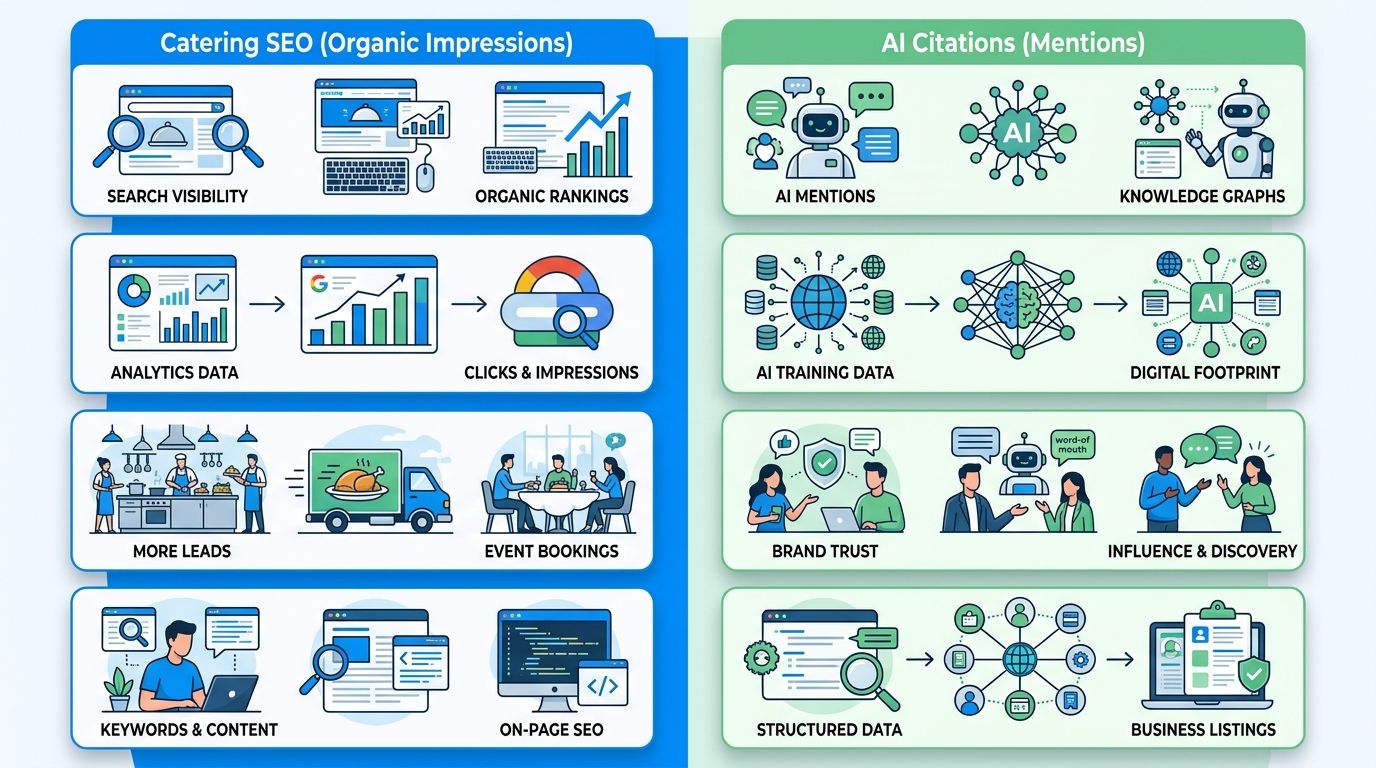
Comparison of organic impressions vs AI citations for catering SEO
Step 6: Optimize Content for LLM Retrieval Systems
Increasing your content’s ai citation frequency requires structuring information in a way that large language models can easily parse and reference. By implementing FAQ schema, using clear hierarchical headings, and building topical authority through pillar pages, you improve your content’s entity knowledge graph density.
Step 7: Monitor and Adjust Your Generative Engine Optimization Strategy
Adopt a monthly review of major AI platforms. Track two core indicators: your entity knowledge graph density and citation frequency. Regular AI citation frequency tracking protects your visibility.
Common Pitfalls in Managing AI Citation Frequency and How to Fix Them
Achieving consistent AI citation frequency requires more than good intentions. Many caterers see their businesses rarely mentioned by ChatGPT because of preventable issues like inconsistent data and missing structured markup.
Turning AI Citation Insights into Predictable Catering Leads
AI citation frequency, the metric tracking how often a catering business is referenced in AI Overviews, directly correlates with lead potential. By monitoring this frequency for local catering queries, we can identify which digital assets carry the most weight with AI models.